


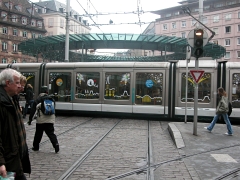
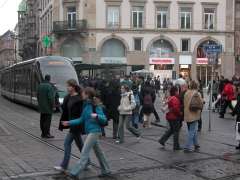
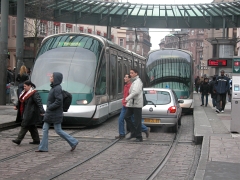
The second example is the > Place Homme de Fer in Strasbourg. No sooner have the trams—which arrive here from four directions—glided past than passersby reclaim the square. Here, the tram is merely a guest; it is tolerated, it can ring its bell, and people make room for it to pass.

Social networks of the well-known type encourage people to reveal as much of their identity as possible; the more information they provide, the better their chances of connecting with others—directly or indirectly—so they are prompted to fill out more and more fields. I suppose that despite the accuracy of the information provided, these networks create a fictional world that has nothing to do with public life.
Public life and interpersonal relationships involve getting to know others while showing respect in every way. Respect for individual integrity and respect for personal views—these are the ground rules that govern how people interact with one another. The chance encounter, the exchange of business cards, and the subsequent follow-up contact that allows us to continue getting to know one another no longer exist.
Only urban spaces where passersby can meet without being hindered by barriers of any kind—we are not discussing here the usefulness of technical traffic regulations that lead to obstructed public squares—can give rise to a public sphere. Public squares that have lost their original function as meeting places no longer serve a purpose in urban society.
Social media, which appear to have no barriers, strip away many dimensions of getting to know someone as a social process; it is as if one were rummaging through the other person’s cards, having meanwhile found information about them on a social network. The timeframe for getting to know someone has been shortened by several weeks; with such carelessness, we merely compare others to our own interests, and the interesting facets of the other person are poorly assessed in terms of their individuality or are not even recognized.
The second thesis is therefore—drawing on Richard Sennett’s work
(The Decline and Fall of Public Life: The Tyranny of Intimacy, in English The Fall of Public Man, Frankfurt am Main, 1983), that social media are by no means “social,” but rather contribute significantly and decisively to the decline of the public sphere, precisely by pretending to be public. The more a shared identity is recognized or developed—the more everyone becomes equal, one might add—the more the pursuit of common interests becomes impossible, explains Sennett (p. 295). This is not necessarily as paradoxical as it seems. Only differences give rise to curiosity and lead to the discovery of something new.
> Urban Planning and Social Networks (IV)
> Urban Planning and Social Networks in Web 2.0 (I)
> Urban Planning and Social Networks in Web 2.0 (II)
> Urban Planning and Social Networks in Web 2.0 (III)
Continue to: > Urban Planning and Social Networks on Web 2.0 (IV)
Le deuxième exemple est la > place Homme de fer à Strasbourg. A peine les tramways, qui viennent ici de quatre directions, ont-ils glissé, que les passants reprennent le contrôle de la place. Le tram n’est ici qu’un invité, il est toléré, il peut sonner, on lui fait de la place pour passer.
Les réseaux sociaux du type connu incitent les gens à révéler le plus possible leur identité ; plus ils sont nombreux, plus on leur promet de meilleures chances de contact avec les autres, directement ou indirectement, afin qu’ils remplissent toujours plus de champs. Je suppose qu’en dépit de la véracité des informations fournies, ces réseaux créent un monde fictif qui n’a rien à voir avec la vie publique.
La vie publique et les relations entre les personnes impliquent la découverte de l’autre sous toutes les formes de respect. Respect de l’intégrité individuelle, respect des attitudes personnelles, telles sont les règles du jeu qui régissent la façon dont les gens se rencontrent entre eux. La rencontre furtive, l’échange de cartes de visite, la reprise de contact qui s’ensuit et qui permet de poursuivre la découverte de l’autre, n’existent plus.
Seuls des espaces urbains dans lesquels les passants se rencontrent sans être entravés par des barrières de toutes sortes – nous ne discutons pas ici de l’utilité des prescriptions techniques de circulation qui conduisent à des places obstruées – peuvent donner naissance à un public. Les places qui ont perdu leur fonction initiale de rencontre n’ont plus d’utilité pour une société urbaine.
Les réseaux sociaux, qui n’ont pas de barrières en apparence, enlèvent de nombreuses dimensions à la connaissance en tant que processus social, c’est comme si l’on piochait dans les cartes de l’autre, si l’on a trouvé entre-temps des informations sur l’autre dans un réseau. La durée de la connaissance a été avancée de plusieurs semaines, avec quelle légèreté on ne fait que comparer avec ses propres intérêts, les facettes intéressantes de l’autre sont mal évaluées dans leur individualité ou ne sont même pas reconnues.
La deuxième thèse est donc, en se rapprochant de Richard Sennett (Déclin et fin de la vie publique. La tyrannie de l’intimité, en anglais The Fall of Public Man, Francfort/M. 1983), que les réseaux sociaux ne sont en aucun cas sociaux, mais qu’ils contribuent considérablement et de manière décisive au déclin de la sphère publique, précisément en faisant semblant d’être publics. Plus l’identité commune est constatée ou développée, plus tous deviennent égaux, pourrait-on ajouter, plus la poursuite d’intérêts communs devient impossible, explique Sennett (p. 295). Ce n’est pas forcément aussi paradoxal qu’il y paraît. Seules les différences font naître la curiosité et conduisent à la découverte de quelque chose de nouveau.
> Stadtplanung und soziale Netzwerke (IV)
> Stadtplanung und soziale Netzwerke im Web 2.0 (I)
> Stadtplanung und soziale Netzwerke im Web 2.0 (II)
> Stadtplanung und soziale Netzwerke im Web 2.0 (III)
weiter mit : > Stadtplanung und soziale Netzwerke im Web 2.0 (IV)
Das zweite Beispiel ist der > Platz Homme de Fer in Straßburg. Kaum sind die Straßenbahnen, die hier aus vier Richtungen kommen, vorbeigeglitten, übernehmen wieder die Passanten die Herrschaft über den Platz. Die Bahn ist hier nur Gast, sie wird geduldet, sie darf klingeln, man macht ihr für die Durchfahrt Platz.
Soziale Netzwerke der bekannten Art verführen die Menschen zu einer möglichst weitgehenden Preisgabe ihrer Identität, je mehr, um so bessere Kontaktchancen mit anderen werden direkt oder indirekt versprochen, damit immer mehr Felder ausgefüllt werden. Ich vermute, daß trotz der wohl oft zutreffenden Angaben in diesen Netzwerken dennoch eine Scheinwelt aufgebaut wird, die mit dem öffentlichen Leben nichts zu tun hat.
Zum öffentlichen Leben und Umgang miteinander gehört die Entdeckung des Anderen unter allen Formen der Wahrung des Respekts. Respekt vor der individuellen Integrität, Respekt vor persönlichen Einstellungen, so lauten die Spielregeln, wie Menschen sich untereinander begegnen. Das flüchtige Kennenlernen der Tausch der Visitenkarten, die folgende erneute Kontaktaufnahme, mit der das Entdecken des Anderen fortgesetzt werden kann, gibt es nicht mehr.
Nur städtischen Räumen, in denen die Passanten sich einander begegnen ohne die Einengung durch Barrieren aller Art – hier wird nicht über den Nutzen der verkehrstechnischen Vorschriften, die zu verbauten Plätzen führen diskutiert – kann eine Öffentlichkeit entstehen. Plätze, die ihre ursprüngliche Funktion der Begegnung verloren haben, haben auch für eine Stadtgesellschaft erstmal keinen Nutzen mehr.
Soziale Netzwerke, die nur augenscheinlich keine Barrieren haben, nehmen dem Kennenlernen als sozialen Prozess viele Dimensionen, es ist wie ein Spicken in die Karten des gegenüber, wenn man zwischenzeitlich in einem Netzwerk Informationen über den Anderen gefunden hat. Die Dauer der Bekanntschaft ist um Wochen vorgespult worden, wie leichtfertig wird nur ein Abgleich mit den eigenen Interessen vorgenommen, interessante Facetten des Gegenübers werden in ihrer Individualität falsch gewichtet oder gar nicht erst erkannt.
Die zweite These lautet also, in Annäherung an Richard Sennett (Verfall und Ende des öffentlichen Lebens. Die Tyrannei der Intimität, engl. The Fall of Public Man, Frankfurt/M. 1983), daß die sozialen Netzwerke keinesfalls sozial sind, sondern zum Niedergang der Öffentlichkeit gerade durch die Vorspiegelung der Öffentlichkeit erheblich und entscheidend beitragen. Je mehr gemeinsame Identität festgestellt oder entwickelt wird, je gleicher alle werden, so möchte man hinzufügen, so unmöglicher wird die Verfolgung gemeinsamer Interessen, erklärt Sennett (S. 295). Das ist nicht unbedingt so paradox, wie es klingt. Nur die Unterschiede lassen die Neugier entstehen und führen zum Entdecken von Neuem.
> Stadtplanung und soziale Netzwerke (IV)
> Stadtplanung und soziale Netzwerke im Web 2.0 (I)
> Stadtplanung und soziale Netzwerke im Web 2.0 (II)
> Stadtplanung und soziale Netzwerke im Web 2.0 (III)
weiter mit : > Stadtplanung und soziale Netzwerke im Web 2.0 (IV)
