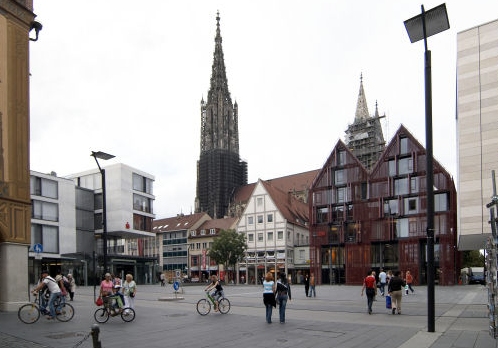
The following four articles summarize the talk given last Saturday at the > Barcamp in Mannheim, where Robert Basic and I asked What is the social nature of social networks? . This presentation was intended to spark discussion; while the debate was highly contentious, it also highlighted the value of social networks.
> Urban Planning and Social Networks in Web 2.0 (I)
> Urban Planning and Social Networks in Web 2.0 (II)
> Urban Planning and Social Networks in Web 2.0 (III)
> Urban Planning and Social Networks in Web 2.0 (IV)
As per the blog, the latest post (i.e., (IV)) appears first here. It is therefore best to scroll down the page or click here to start with > Urban Planning and Social Networks on Web 2.0 (I).
In social networks such as > Facebook, there is no hierarchy, unless the number of contacts indicates something about social status. It primarily reflects the amount of time the well-known person has already spent on this platform. No one walks across a public square and greets everyone with a handshake, because they know everyone passing by. Unfortunately, the person we know well becomes an object for which we vote.
Sennett raises the question—and explicitly rejects it—that a society cannot build a community based on intimate acquaintances. ((The Decline and End of Public Life: The Tyranny of Intimacy, in English The Fall of Public Man, Frankfurt am Main, 1983, p. 333) Applied to social media, this means that no network can be created based on knowledge of profiles, since lasting reciprocity is not involved. What is discussed here on a small scale can be applied to urban design and urban planning. A prime example will soon emerge in Stuttgart. The removal of the railroad tracks, the 90-degree rotation of the train station, and the construction of a new neighborhood on the site of the numerous railroad tracks that currently lead to a terminal station are collectively known as Stuttgart 21. Commercial buildings, residential units, and the 21st-century library are set to rise from the former track area.
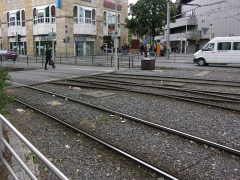
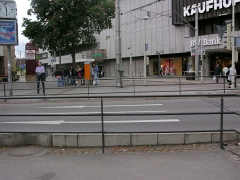
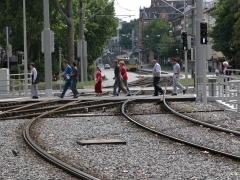
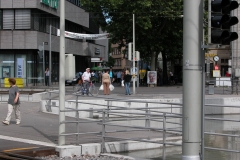
A few images from the early days, around 2003, of the development behind Stuttgart’s central station:


Can a neighborhood be created from scratch? Urban planners are convinced it can. It is hoped that this new neighborhood will have a ripple effect on the surrounding area, as the size of the site makes it a significant urban planning project—even if it is just one neighborhood. The mix of functions in this new neighborhood will be key to its success. What influences will come from outside? What functions will be brought together there? There is no doubt that the urban planners are aware of their responsibility, for they know that it is not enough simply to build houses; rather, they are building—in the truest sense of the word—the social fabric of the new neighborhood. Its prospects are set in stone and may only have proven viable after the inauguration, to truly lay the foundation for an urban community.
It is not the architecture of the houses, but the functions of the various buildings that determine how society can be built. The 21st-century library, located at the heart of the new neighborhood, will reportedly be surrounded by a moat. It is possible that it will be accessible only through a gate on one side, facing downtown. Just as the arrangement of functions will determine the well-being and comfort of work in this new neighborhood—and, to a lesser extent, in the new library—these sociological perspectives and insights into urban planning must also be applied to the rules and functions of social networks, which constitute the conditions for society’s success.
Urban planning and social networks differ very little from one another. And these conditions are shaped by those who receive money for making the budget available. Paying for one’s own advertising on a regular basis—like a hairdresser’s ad or the monthly gas bill—is still something that takes some getting used to. For some, this amount is even a kind of tax on livelihood.
To the first article in the series > Urban Planning and Social Networks in Web 2.0
Supplement:
Kai Biermann,> Networking Can Hurt, DIE ZEIT, Oct. 21, 2008
Les quatre articles suivants sont un résumé de la conférence donnée samedi dernier lors du > Barcamp in Mannheim, sur laquelle Robert Basic et moi-même avons demandé Quel est le caractère social des réseaux sociaux?. cette contribution était destinée à ouvrir la discussion, qui a été très controversée, mais a également permis de reconnaître l’utilité des réseaux sociaux.
> Stadtplanung und soziale Netzwerke im Web 2.0 (I)
> Stadtplanung und soziale Netzwerke im Web 2.0 (II)
> Stadtplanung und soziale Netzwerke im Web 2.0 (III)
> Stadtplanung und soziale Netzwerke im Web 2.0 (IV)
Conformément au blog, le dernier article (donc (IV)) est ici en premier. Il est donc préférable de faire défiler la page ou de cliquer ici pour commencer par > L’urbanisme et les réseaux sociaux sur le web 2.0 (I).
Dans les réseaux sociaux comme > Facebook, il n’y a pas de hiérarchie, à moins que le nombre de contacts n’indique quelque chose sur la position sociale. Il reflète d’abord les heures que la personne souvent connue a déjà passées sur cette plate-forme. Personne ne traverse une place publique et ne salue tout le monde en lui serrant la main, car il connaît tous ceux qui passent devant lui. Malheureusement, la personne que l’on connaît bien devient un objet pour lequel on vote.
Sennet pose la question, et la nie explicitement, qu’une société ne peut pas construire une communauté sur la base de connaissances intimes. ((Déclin et fin de la vie publique. La tyrannie de l’intimité, en anglais The Fall of Public Man, Francfort/M. 1983, p. 333) Appliqué aux réseaux sociaux, cela signifie qu’aucun réseau ne peut être créé sur la base de la connaissance de profils, car la réciprocité durable n’est pas impliquée. Ce qui est évoqué ici à petite échelle peut être transposé à l’urbanisme et à la planification urbaine. Un exemple type se présentera prochainement à Stuttgart. Le dégagement des voies ferrées, la rotation de la gare de 90 degrés et la construction d’un nouveau quartier sur le site des nombreuses voies ferrées qui aboutissent aujourd’hui à une gare terminus sont proclamés Stuttgart 21. Des immeubles commerciaux et des logements ainsi que la bibliothèque du 21e siècle doivent surgir de l’ancienne zone des voies.
Quelques images des premiers jours, vers 2003, de l’aménagement derrière la gare centrale de Stuttgart :
Peut-on créer un quartier de toutes pièces ? Les urbanistes en sont convaincus. On espère que ce nouveau quartier aura un effet d’entraînement sur les environs, car la taille du terrain en fait un objet d’urbanisme, même si ce n’est qu’un quartier. Le dosage des fonctions dans ce nouveau quartier sera déterminant pour son succès. Quelles influences viendront de l’extérieur ? Quelles fonctions y seront regroupées ? Il ne fait aucun doute que les urbanistes sont conscients de leur responsabilité, car ils savent qu’il ne suffit pas de construire les maisons, mais qu’ils construisent, au sens le plus vrai du terme, la structure sociale du nouveau quartier. Ses chances sont gravées dans la pierre et ne se sont peut-être révélées viables qu’après l’inauguration, pour fonder réellement une société urbaine.
Ce n’est pas l’architecture des maisons, mais les fonctions des différents bâtiments qui déterminent la manière dont la société peut se construire. La bibliothèque du 21e siècle, située au cœur du nouveau quartier, sera, paraît-il, entourée d’un fossé. Il est possible que l’on ne puisse y accéder que par une porte située d’un côté, face au centre-ville. De même que l’agencement des fonctions déterminera le bien-être et le confort du travail dans ce nouveau quartier et, dans une moindre mesure, dans la nouvelle bibliothèque, ces perspectives et connaissances sociologiques de l’urbanisme doivent également être appliquées aux règles et fonctions des réseaux sociaux, qui constituent les conditions de réussite de la société.
SL’urbanisme et les réseaux sociaux ne se distinguent que très peu l’un de l’autre. Et ces conditions sont faites par ceux qui reçoivent de l’argent pour la mise à disposition de l’enveloppe. Payer régulièrement sa propre publicité, comme celle du coiffeur ou la facture de gaz mensuelle, est encore une chose à laquelle il faut s’habituer. Pour certains, ce montant est même une sorte d’impôt sur la subsistance.
Vers le premier article de la série > Stadtplanung und soziale Netzwerke im Web 2.0
Complément :
Kai Biermann,> Vernetzen kann verletzen, DIE ZEIT, 21.10.2008
Die folgenden vier Beiträge sind eine Kurzfassung des Vortrags am letzten Samstag auf dem > Barcamp in Mannheim, auf der Robert Basic und ich gefragt haben, Wie sozial sind soziale Netzwerke?. dieser Beitrag war als Eröffnung der Diskussion gedacht, die sehr kontrovers geführt wurde, aber auch den Nutzen sozialer Netzwerke erkennen ließ.
> Stadtplanung und soziale Netzwerke im Web 2.0 (I)
> Stadtplanung und soziale Netzwerke im Web 2.0 (II)
> Stadtplanung und soziale Netzwerke im Web 2.0 (III)
> Stadtplanung und soziale Netzwerke im Web 2.0 (IV)
Bloggemäß steht der neueste Beitrag (also (IV) hier zuerst. Also am besten einfach runterscrollen oder hier klicken, um mit > Stadtplanung und soziale Netzwerke im Web 2.0 (I) anfangen.
In sozialen Netzwerken wie > Facebook gibt es keine Hierarchie, es sei denn die Anzahl der Kontakte würde etwas über die soziale Stellung aussagen. Sie spiegelt zuerst die Stunden wieder, die der Vielbekannte schon auf dieser Plattform verbracht hat. Keiner geht über einen öffentlichen Platz und begrüßt jedem mit Handschlag, weil er alle, die an ihm vorübereilen kennt. Leider wird der Vielbekannte zu einem Objekt, für das eine Stimme abgegeben wird.
Sennet stellt die Frage und verneint sie ausdrücklich, dass eine Gesellschaft aufgrund intimer Kenntnisse keine Gemeinschaft errichten kann. ((Verfall und Ende des öffentlichen Lebens. Die Tyrannei der Intimität, engl. The Fall of Public Man, Frankfurt/M. 1983, S. 333) Auf die sozialen Netzwerke übertragen, bedeutet dies, dass aufgrund der Kenntnisse von Profilen kein Netzwerk entstehen kann, weil die nachhaltige Gegenseitigkeit nicht impliziert wird. Was hier im kleinen Rahmen angedeutet wird, kann auf den Städtebau und die Stadtplanung übertragen werden. Demnächst bietet sich wieder in Stuttgart dazu ein Musterbeispiel an. Das Freiräumen der Gleisanlagen, die Drehung des Bahnhofs um 90 Grad und der Bau eines neuen Stadtviertels auf dem Gebiet der vielen Gleise, die heute in einem Kopfbahnhof enden, wird als Stuttgart 21 ausgerufen. Aus dem ehemaligen Gleisbereich soll Geschäftshäuser und Wohnungen sowie die Bibliothek des 21. Jahrhunderts emporwachsen.
Einige Bilder aus den Anfangstagen um 2003 der Bebauung hinter dem Stuttgarter Hauptbahnhof:
Kann man einen Stadtteil aus der Retorte schaffen? Die Stadtplaner zeigen sich davon überzeugt. Man erhofft sich für den neuen Stadtteil eine Sogwirkung, der seine Umgegend mitreißen wird, denn die Größe des Geländes macht es zu einem Objekt der Stadtplanung, auch wenn es nur eine Stadtteilplanung ist. Die Dosierung der Funktionen in diesem neuen Stadtteil wird über seinen Erfolg entscheiden. Welche Einflüsse kommen von außen? Welche Funktionen werden dort gebündelt? Ohne Zweifel sind sich die Stadtplaner ihrer Verantwortung bewußt, denn sie wissen, dass es nicht genügt, die Häuser zu bauen, sie bauen in wahrstem Sinne der Sache an der gesellschaftlichen Struktur des neuen Stadtteils. Seine Chancen werden in Stein gehauen und erwiesen sich vielleicht erst nach der Einweihung als tragfähig, wirklich eine städtische Gesellschaft zu begründen.
Die Art und Weise, wie die Wege der Menschen durch das neue Häuserensemble gestaltet werden, nicht die Architektur der Häuser, sondern die Funktionen der einzelnen Gebäude entscheiden darüber wie die Gesellschaft sich gestalten kann. Die Bibliothek des 21. Jahrhunderts inmitten des neuen Stadtteils wird dem Vernehmen nach von einem Wassergraben umgeben sein. Möglicherweise wird sie nur durch eine Tür auf einer Seite, die der Innenstadt zugewandt sein wird, zu betreten sein. Sowie die Anordnung der Funktionen über das Wohl und Wehe des Arbeitens und des Wohlfühlens in diesem neuen Stadtteil und in einem kleineren Rahm in der neuen Bibliothek entscheiden wird, so sind diese Perspektiven und soziologischen Erkenntnisse aus dem Städtebau auch auf die Regeln und Funktionen in sozialen Netzwerken die Erfolgsbedingungen für das Entstehen der Gesellschaft ausmachen zu übertragen.
Stadtplanung und soziale Netzwerke unterscheiden sich nur wenig voneinander. Und diese Bedingungen werden von denen gemacht, die für die Zurverfügungstellung der Hülle Geld bekommen. Das regelmäßige Bezahlen der eigenen Bekanntmachung wie die des Frisörs oder der monatlichen Gasrechnung ist noch sehr gewöhnungsbedürftig. Für manche ist dieser Betrag gar eine Art Existenzsteuer.
Zum ersten Beitrag der Serie > Stadtplanung und soziale Netzwerke im Web 2.0
Ergänzung:
Kai Biermann,> Vernetzen kann verletzen, DIE ZEIT, 21.10.2008

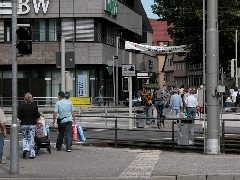 It may be possible to address this problem through architecture or urban planning. Let us consider, in turn, two squares that are intended to serve as spaces for public life. Wilhelmsplatz (I) in Stuttgart-Bad-Cannstatt (>